- Training 3D Animation & FX
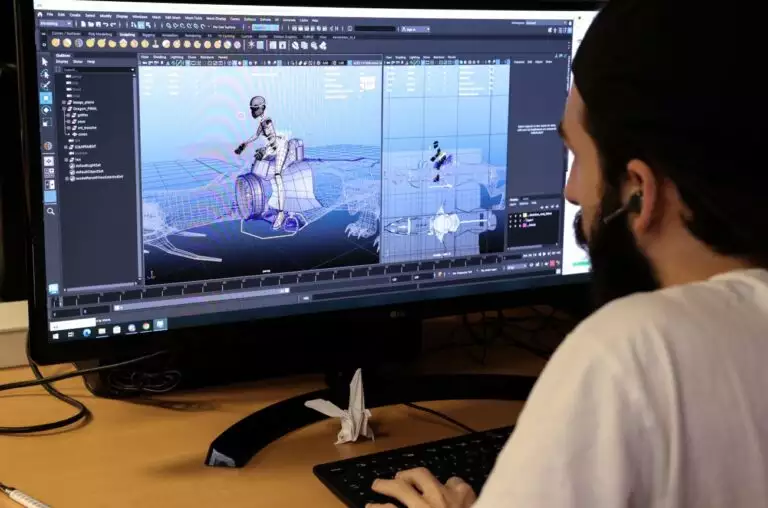
A rigger is a 3D professional who builds the digital skeletons, controls, and deformation systems that allow characters, creatures, props, and vehicles to move correctly in animation. To become a rigger, you usually need solid 3D fundamentals, a good understanding of movement and character structure, experience with software such as Maya or Blender, and a portfolio that shows clean, animator-friendly rigs.
What does a rigger do in 3D animation?
A rigger creates the technical setup that makes animation possible. In practice, that means building the bones, controllers, and movement systems that let a 3D character bend, stretch, turn, and perform naturally on screen.
This role sits between modeling and animation. A character may look excellent as a model, but without a strong rig, it can be difficult to animate convincingly. A good rigger helps animators work more efficiently by giving them stable, intuitive controls and making sure movement remains believable throughout production.
Riggers can work on far more than bodies. They may also rig faces, hands, creatures, props, vehicles, and sometimes cameras or other technical elements needed for a scene. That is why the role requires both technical precision and a strong understanding of movement.
Why rigging is important in animation
Rigging has a direct effect on animation quality. When a rig is clear, stable, and easy to use, animators can focus on acting, timing, and performance instead of struggling with broken controls or weak deformations. In other words, a better rig usually leads to a smoother workflow and stronger animation results.
Rigging is also important across multiple industries. Riggers work in animated film, visual effects, games, advertising, and real-time 3D production, where characters and objects need reliable movement systems before animation can happen efficiently.
Skills you need to become a rigger
To become a rigger, you need a mix of technical ability, artistic awareness, and production understanding. The strongest professionals in this field combine problem-solving with a clear sense of how characters and objects should move in animation.
Key skills include:
- understanding anatomy and movement so you can build rigs that support believable motion
- knowledge of topology and deformation so bends, twists, and facial expressions behave correctly
- problem-solving ability to find clean solutions for difficult technical situations
- observation skills to understand how bodies, faces, and mechanical objects move
- pipeline awareness because rigging sits between modeling and animation
- communication and collaboration when working with modelers, animators, and other artists
- technical logic for creating usable, efficient controls
- basic scripting knowledge in some workflows, especially when automation or custom tools are useful
Software used by 3D riggers
Maya is one of the most widely used tools for character rigging in professional production, and Blender is also commonly used for learning and production work. Both are relevant for aspiring riggers who want to develop practical, production-ready skills.
Useful software knowledge for a rigger includes:
- Maya for character rigging and production-oriented workflows
- Blender for rigging practice, independent work, and broader 3D production
- skinning and weighting tools to control how meshes deform
- constraint and controller systems to build practical animation controls
- scene organisation tools to keep rigs clean and usable
- Python or scripting tools when studios need automation or custom rigging utilities
The key point is not just knowing software names. You need to know how to use those tools to build rigs that are stable, efficient, and easy for animators to work with.
How to become a rigger step by step
Learn the fundamentals of 3D animation
A strong rigger usually begins with a broad understanding of 3D production. That means learning how characters are modeled, how they are animated, and how the different stages of the pipeline connect. Because rigging sits between modeling and animation, this wider foundation is extremely valuable.
Understand character structure and movement
Before you can build a useful rig, you need to understand what the rig is supporting. Study body mechanics, facial movement, proportions, weight transfer, and deformation. A rig should not only function technically. It should also support believable movement on screen.
Practice rigging different types of assets
Start with simple character rigs, then progress toward more advanced setups. Practice body rigs, facial rigs, props, and mechanical objects. This helps you understand different rigging challenges and prepares you for real production needs.
Learn the software used in production
Develop practical ability in tools such as Maya and Blender. Focus on joints, skinning, controls, constraints, deformation systems, and clean scene organisation. Software knowledge matters, but employers also look for rigging logic and production awareness.
Build a portfolio
A portfolio is one of the most important steps in becoming a rigger. It should show that you can create rigs that work well for animation, solve technical issues clearly, and handle a range of assets. Strong portfolio examples often demonstrate body mechanics, facial controls, deformation quality, and animator-friendly usability.
Apply for junior roles and keep improving
Entry routes can include junior rigger positions, trainee opportunities, or broader technical animation roles that lead into rigging work. With experience, riggers can develop into more advanced technical or supervisory roles within animation, visual effects, and game production.
Rigger salary
Salary can vary significantly depending on experience, location, studio type, and specialisation. That is why it is more accurate to present rigger salary as a range rather than a single figure.
Recent salary benchmarks suggest that many rigging roles fall roughly in the $50,000 to $95,000 USD range per year. More experienced or lead-level riggers can earn over $100,000 USD, depending on the market, the studio, and the level of responsibility.
Why study 3D animation to become a rigger?
Rigging is easier to learn well when you understand the full animation pipeline. A strong 3D animation education helps you see how modeling, movement, performance, and technical setup all connect. That matters because a rigger does not work in isolation. The role supports animators, depends on strong models, and has to fit into production workflow.
For that reason, studying a broader CG and animation course can be a strong path into rigging. ESMA’s CG Animation & FX training gives students exposure to the wider production environment that supports specialisations such as rigging.
It also makes sense to explore related career paths such as becoming a 3D modeler and become 3D Animator, since both fields connect closely to rigging in professional production.
FAQ
What qualifications do you need to become a rigger?
There is no single required qualification, but most aspiring riggers benefit from structured training in 3D animation, character setup, and production workflow. Employers usually care most about your skills, software knowledge, and portfolio.
Do riggers need to know animation?
Yes. A rigger does not need to start as an animator, but understanding animation is very important. You need to know what animators need from a rig and how movement should behave on screen.
Is rigging a good career in 3D animation?
Rigging is a strong career path for people who enjoy both art and technical problem-solving. It is used across animation, visual effects, games, and real-time production, which gives the role broad relevance in the industry.
What software do riggers use?
Maya is one of the best-known tools in professional rigging workflows, and Blender is also widely used. Some studios also value scripting knowledge, especially Python, for automation and custom tools.
How much does a rigger earn?
Many rigging roles fall roughly in the $50,000 to $95,000 USD range per year, while senior and lead positions can exceed $100,000 USD depending on experience, specialisation, and market conditions.