-
- Promotion 2024
- Training Video Game
- currently works at Honikou Studio
- position 3D Artist
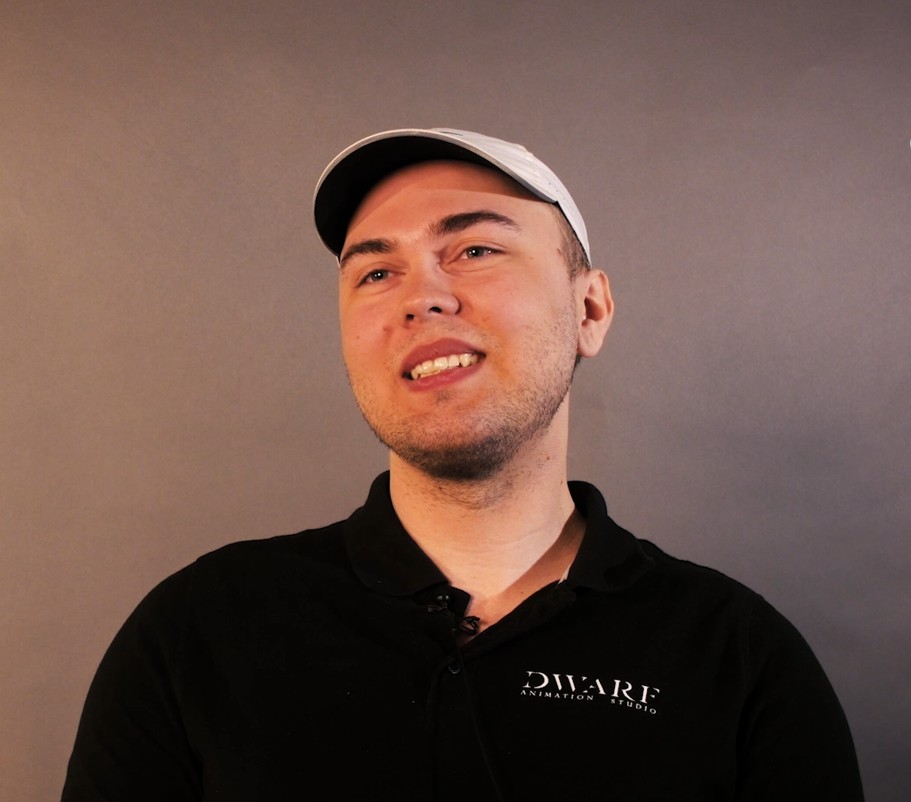
A 2024 graduate of ESMA, Giovan Buiatti now works as a 3D Artist at Honikou Studio. His career is still in its early stages, but has already been marked by several significant experiences: undertaking a demanding course of study, a gradual move towards specialisation, a memorable first professional project, and entering an industry where his passion remains undiminished despite a job market that has become more challenging for junior professionals.
Would you like to share your experience at ESMA?
Please feel free to contact Angélique Ribas, Content Manager, to share your alumni story.
Mail
[email protected]
A comprehensive training programme to build a solid foundation
When he joined ESMA in 2021, Giovan Buiatti arrived with a clear idea in mind: he needed a comprehensive training programme. He wasn’t just looking to learn a particular piece of software or an isolated specialism, but to build a solid foundation across the entire 3D creation process. “I was really starting from scratch in every respect,” he explains.
That is precisely what attracted him to the school: a versatile approach to begin with, followed by gradual specialisation over the years.
This model suited his needs at the time. Before choosing a specific field, he needs to understand the stages, the roles, the tools and the methods. ESMA offers him this progression from A to Z, with the time needed to discover, experiment and then refine his direction.
“It was a school that offered a very versatile approach to training, where, as the years went by, we specialised in the aspect of the industry that appealed to us most,” he sums up.
From versatility to mastery of professional tools
This development of skills naturally involves learning professional software. Maya, Photoshop and other creative tools gradually became part of his daily working life.
Even today, they remain at the heart of his profession. The training enabled him to acquire the technical proficiency essential for thriving in a production environment, where mastery of the tools must serve a visual purpose whilst also meeting practical constraints.

A close-knit group as the driving force behind the journey
However, it isn’t just the software that stands out in his memories of school. What he remembers most vividly is the group. The class. The human connection.
“We really were a very close-knit group,” he says.
This may seem like a minor detail, but it played a significant role in his daily life as a student. Waking up every morning looking forward to seeing the people he worked, discussed ideas and laughed with adds a whole new dimension to the course.
This sense of community is all the more important in a demanding course of study, where long hours are the norm and projects often take up a great deal of time. Giovan’s memory of this period is one of intense dedication, fuelled by a shared sense of energy.
The school is not just a place for technical learning; it also becomes a shared creative environment, where you progress alongside others as much as you do on your own.
Modelling, texturing, integrating: the daily life of a 3D Artist
Today, his role as a 3D Artist involves working on assets for interactive or visual productions. A task might begin with creating an object: a weapon, a piece of furniture, a set piece or any other item required for a project.
First, it needs to be modelled in 3D software such as Maya, Blender or 3ds Max, then textured. Giovan puts it simply: texturing is ‘like colouring in the asset’.
Once the object has been modelled and textured, it still needs to be integrated into a game engine. Depending on the project, this might involve Unreal Engine or Unity, the engine he’s currently working on.
His day-to-day work therefore lies at the intersection of several skills: an understanding of form, an eye for detail, production logic, technical constraints and optimisation for a real-time engine.
From student life to studio life
This transition from university to the studio has also allowed him to rethink certain preconceptions. During his studies, Giovan imagined that entering the industry would necessarily mean working extremely hard.
The reality turned out to be more nuanced.
“I work far less than I did when I was a student,” he says.
Not because the job is any less demanding, but because professional life imposes a different rhythm. Once the working day is over, time becomes more clearly one’s ownagain.
At school, on the other hand, the nature of learning often pushes you to carry on, to perfect your skills, to progress, and to strive to become better in your field. That intensity is part of the journey. It also prepares you for independence. But the world of work brings him a sense of balance that he hadn’t necessarily anticipated.
What remains unchanged, however, is the joy of creating. Giovan says he doesn’t feel as though he’s ‘doing a job’ in the burdensome sense of the term. What motivates him day in, day out, is the chance to make new things, to add his own touch to a project, whether it’s large-scale or on a smaller scale.
“I feel like I’m having fun every day,” he says.
A simple sentence, but one that says a great deal about what led him to these professions.

Twisted, a memorablefirst professional experience
Among his early professional experiences, one project holds a special place: Twisted, a feature film by Dwarf Animation Studio on which he worked.
This project marked his entry into the industry. But it also involved working with a team he describes as exceptional, made up of immensely talented people. This encounter with highly experienced professionals had an immediate effect: it brought him back down to earth.
“It brought me back down to earth,” he admits.
In an industry where standards are high, gaining a real sense of the calibre of the people you work with allows you to gauge how far you’ve come, but also how far you still have to go. This realisation isn’t discouraging. On the contrary, it fuels the desire to improve.
When video games meet animation
Twisted was also significant for another reason: Giovan felt he had a unique role to play there.
Recruited partly for his video game skills, he was able to bring methods and techniques from that world to the production. This bridge between video games and animation allowed him to contribute in a different way, by introducing approaches that were not necessarily known or used in the traditional animation pipeline.
This experience underscores an important aspect of his career: initial versatility, followed by gradual specialisation, can become a real asset.
Being able to bridge the gap between different production fields, understanding the dynamics of real-time systems and the constraints of animation, and knowing how to adapt techniques from one sector to another: these are all skills that can give a young professional particular value.
Starting out in a more selective industry
Looking ahead, Giovan has set himself a simple goal: to continue working in the industry. To stay active, take on increasingly challenging projects, keep improving,andbecome even better at what he does.
Behind this ambition lies a clear-eyed awareness of the current climate. The industry is going through a difficult period, particularly for junior staff. Redundancies have increased in several studios, whilst new hires have become scarce.
This situation is creating fiercer competition. Professionals who have been made redundant often have several years’ experience, which naturally puts them ahead of recent graduates when it comes to many opportunities.
“They’re taking jobs away from junior staff, and it’s having a snowball effect,” observes Giovan.
For those fresh out of school or just starting out, finding a job is therefore becoming particularly difficult.
He himself remains vigilant. On a fixed-term contract, he knows he must plan ahead, get back in touch with studios and prepare the next steps before his contract ends. He doesn’t believe that an opportunity will simply fall into his lap.
In this sector, you have to make yourself visible, maintain your network, showcase your work and keep moving.
His advice to junior professionals: work hard, showcase your work, and stay visible
His advice to students and recent graduates boils down to this: don’t wait passively.
Keep working – sometimes more than is necessary – to stand out. Not to the point of exhaustion, but because excellence remains a decisive factor in securing a top position.
“It’s by being the best of the junior staff that you get a job,” he sums up.
Would you like to share your experience at ESMA?
Please feel free to contact Angélique Ribas, Content Manager, to share your alumni story.
Mail
[email protected]